Multifamily Delinquency: Early Warning Signs Before It Hits the P&L
What is the apartment delinquency rate?
Apartment delinquency rate is rent past due divided by rent billed, usually tracked at 30+ days. It's an early warning for bad debt, which reaches the P&L months later when balances are written off. Track it by age (1–30, 31–60, 61–90 and 90+ days) and by number of units. The warning signs show up before the write-off: more late payers and partial payments, collections slipping later in the month, balances moving into older buckets, broken payment plans, delinquency among recent move-ins, renewals going to residents who owe rent, and rising credit stress among the property's residents and neighborhood.
How to measure apartment delinquency rate
Use the aged receivables report from the property management software, and measure four things:
-
Delinquency rate (all) = Rent past due ÷ Monthly rent billed. The 30+ delinquency rate counts only balances 30 or more days past due; the thresholds below use it
-
Delinquent units = Units with rent past due ÷ Occupied units
-
Aging mix = Share of the past-due balance in each age bucket (1–30, 31–60, 61–90, 90+ days)
-
Collection rate = Rent collected in the month ÷ Rent billed in the month (current-month rent only; including prior balances can push it over 100%)
For example, $9,000 past due on $300,000 of monthly rent billed is a 3.0% delinquency rate.
Three adjustments keep the numbers honest. Separate rent from fees (late fees, utility bills, damages), since fees are collected less reliably and often waived, so they overstate what's collectible. Show subsidy payments separately, since housing assistance often arrives on its own schedule and can look late when it isn't. And compare the same day each month, because delinquency is always highest right after rent is due and falls as payments come in.
Early warning signs
The delinquency rate tells you where you are. The other signs tell you where it's going. Thresholds are starting points: older, lower-rent properties usually run a higher baseline, so set levels against each property's own history. For older Class B and C assets, a reasonable start is the trailing 12-month average plus half a point.
| Sign | What it tells you | Watch | Act |
|---|---|---|---|
| Delinquency rate, 30+ days | How much rent is seriously late | Over 1.5% | Over 2%, or rising three months in a row |
| Aging mix | Whether balances are getting older instead of being paid | Share over 60 days rising two months in a row | Over half the 30+ balance is 61+ days |
| Delinquent units | How widespread the problem is | Over 5% of occupied units | Over 8% |
| Partial payments | Residents who can pay some but not all | Count rising two months in a row | — |
| Returned payments | Payments that bounced or were reversed | Above the 3-month average | — |
| Broken payment plans | Plans that have missed an installment | Over 20% of active plans | Over a third |
| Early-tenure delinquency | Share of delinquent units that moved in within 6 months, compared with the share of all occupied units that did | 1.5× the occupied-unit share | 2× |
| Renewals with a balance | Renewals due to residents 30+ days past due | — | Any: clear the balance or agree on a plan first |
| Resident and neighborhood credit stress | Credit utilization and past-due rates among the property's residents (in aggregate) and the surrounding blocks, vs. a year ago | Rising | Rising faster than the county |
| Payment timing drift | Share of rent collected by day 5, vs. the trailing 6-month average: stress shows before balances age | 5 points below | 10 points below |
| First-payment default | New residents who miss their first full month's rent, or whose income documents fail verification | Any | 2 or more in a quarter |
| Move-outs with balances | Skips, evictions and move-outs owing money: where write-offs come from | Above the 3-month average | — |
Resident credit data is aggregated across the property and never shows, or should be used for, any one resident. It's useful because many residents pay rent before other bills, so stress often shows up first in card balances and other accounts. Comparing the property with its neighborhood and the county tells you whether rising delinquency is a local trend or a property problem. It's a portfolio monitoring signal only: it isn't a consumer report, and it's never used for screening, renewal, pricing or marketing decisions about any person or area.
How delinquency reaches the P&L
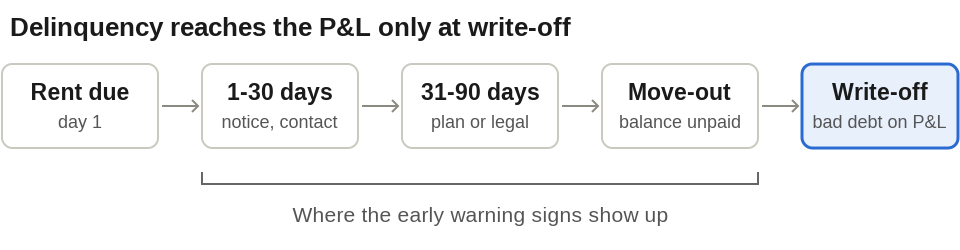
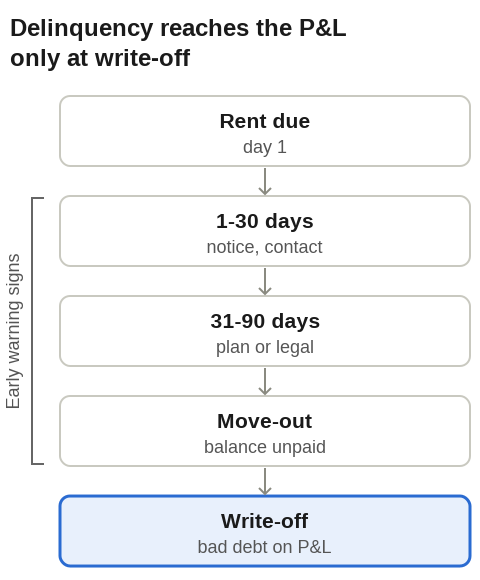
On an accrual P&L, rent is booked when it's billed, so a resident who stops paying doesn't change revenue at first. The loss shows up as bad debt when the balance is reserved or written off, often after a payment plan fails, a legal process runs its course or the resident moves out. On most property operating statements, bad debt is a deduction from revenue, alongside vacancy and concessions, so it lowers EGI and NOI; under GAAP lease accounting, uncollectible rent reduces rental income. By then the warning signs have been visible for weeks or months.
That's why the 61–90 day bucket matters most to an asset manager: much of it becomes next quarter's bad debt unless it's collected or put on a plan that holds. Some owners book a bad debt reserve against it each month so the P&L doesn't take the hit all at once, and collections recover part of what's written off later. Rules on late notices, payment plans and evictions vary by state and city, so the timing differs by market.
Who does what
The property manager: daily and weekly. They own collections.
-
Contact every late resident within the first few days, before the balance grows. Most late payments are resolved by a call or message.
-
Send late notices on the schedule local law requires, and apply the same policy to every resident.
-
Offer payment plans with a written schedule, and track each installment. A missed installment is the signal to move to the next step.
-
Check each unit's balance before renewal offers go out, and collect it or set up a plan first.
-
Separate subsidy timing from true delinquency, and follow up with the agency on late assistance payments. Don't count late subsidy payments against the resident.
The asset manager: weekly exceptions, monthly trends. They don't call residents; they check that the policy is working.
-
Each week, review the 61–90 day bucket and any renewal going to a resident with a balance.
-
Each month, track the delinquency rate, aging mix, payment-plan performance and bad debt against budget.
-
Compare the trend with credit data for the property's residents, the surrounding neighborhood and the county. If the area is steady and the property isn't, look at the property: collection follow-up, screening, or a change in the resident base.
-
Approve write-offs above an agreed amount, and review collections recovery.
-
When early-tenure delinquency or first-payment defaults rise, review screening and income verification with the property manager. Any change to screening criteria should be reviewed with fair housing counsel and tested for whether it actually predicts tenancy outcomes.
Worked example: a monthly delinquency review in Houston
The building is a hypothetical 260-unit, 1980s property in Houston (Harris County, TX) with 248 occupied units and $360,000 of monthly rent billed. Its figures are a sample; the area credit figures are county data.
| Sign | Property (sample) | Threshold: watch / act | Status | Next step |
|---|---|---|---|---|
| Delinquency rate, 30+ days | 2.3% ($8,280 of $360,000), up from 1.4% and 1.7% the two prior months | Over 1.5% / 2% | 🔴 Act | Contact every 30+ day resident this week and report back by unit count. |
| Aging mix | 54% of the 30+ balance ($4,470) is 61+ days | Rising / over half | 🔴 Act | Property manager: put each 61+ balance on a plan or start the legal process under local rules. Asset manager: reserve what remains. About $4,500 is at risk of becoming next quarter's bad debt. |
| Delinquent units | 17 of 248 (6.9%) | Over 5% / 8% | 🟠 Watch | Check next month. |
| Partial payments | 11 this month, up from 7 and 9 | Rising two months | 🟠 Watch | Offer payment plans before balances age. |
| Broken payment plans | 4 of 9 active plans missed an installment | Over 20% / a third | 🔴 Act | Review plan terms; plans that are too long or too large break. Move missed installments to the next step. |
| Early-tenure delinquency | 7 of 17 delinquent units (41%) moved in within 6 months, vs. 38 of 248 occupied units (15%): 2.7× | 1.5× / 2× | 🔴 Act | Check for first-payment defaults and failed income verification, then review screening with the property manager and fair housing counsel. |
| Renewals with a balance | 3 renewals due to residents 30+ days past due | Any | 🔴 Act | Collect the balance or set up a plan before these offers go out. |
| Returned payments | 3, in line with the 3-month average | Above the average | 🟢 In line | — |
| County credit stress | 9.6% of county residents' credit accounts reported past due, up 1.0 point on a year ago | Rising | 🟠 Watch | Part of the rise is local. Compare the property's residents and neighborhood with the county; the property signs above go beyond the county trend. |
Area figures: county credit data as of Oct 1, 2026 (see Sources).
Area credit is weakening in Harris County, so some rise in delinquency is expected. But broken plans and early-tenure delinquency are property problems, and the old balances are where the next quarter's bad debt will come from. The property manager's job this month is the 61+ bucket; the asset manager's is the screening and payment-plan policy.
How RealAI catches delinquency early
Asset Monitor, a feature of RealAI Enterprise, watches for delinquencies building toward the P&L. It connects to your property management software, or reads the reports you already have, and can add RealAI's credit data: aggregate credit trends for property's immediate neighborhood and the county. Rising card utilization or past-due rates among a property's residents can show stress before it reaches rent payments, and the comparison tells you whether it's a local trend or a property problem.
On each run, daily, weekly,or monthly, it checks every unit's balance and age against the thresholds you set. Before renewal offers go out, it checks each unit's delinquency and tells the property manager whether a balance needs to be cleared first. You can add your own metric and thresholds.
When a unit crosses a threshold, Asset Monitor drafts the message to the on-site team, reads the reply and keeps a live task list by property showing what's still open and for how long.
FAQs
What is a normal delinquency rate for apartments?
It depends on the property's age, rent level and market. This guide uses 30+ day delinquency over 1.5% of monthly rent as a point to watch and over 2% to act, set against each property's own history.
How do you calculate multifamily delinquency?
Divide rent past due by monthly rent billed. $9,000 past due on $300,000 billed is 3.0%. Track it by age bucket and by unit count too.
What's the difference between delinquency and bad debt?
Delinquency is rent that's late but may still be collected. Bad debt is rent written off as uncollectable, and it's what hits the P&L.
When should a delinquent balance be written off?
Usually after the resident has moved out or a payment plan or legal process has run its course, under the owner's policy. Many owners also book a monthly reserve against older balances.
Should you renew a resident who owes rent?
Not before the balance is dealt with. Collect it or agree on a payment plan first; otherwise the renewal carries the debt into a new lease term.
Sources
- Area credit data: RealAI SuperCensus for Harris County, TX (as of Oct 1, 2026; about 2.8 million adults in the sample, anonymized at the ZIP+4 level). Accessed Nov 23, 2026.