How Long Should a Ready Unit Sit Vacant?
Days vacant is the number of days an apartment sits without a resident, from move-out to the next move-in. Split it into make-ready days (move-out to ready), ready-vacant days (ready to a signed lease) and signed-to-move-in days (signing to move-in). A ready unit that sits vacant past about 14 days deserves a question, and in a busy market well before that; compare it with how long units take to lease locally. Each vacant day costs roughly the unit's monthly rent divided by 30.
The worked example uses market data from RealAI, the real estate analyst built by Fundrise. Fundrise has bought, financed or managed 35,000+ residential units and has $7B in assets.
Below: how to measure days vacant, how long is too long, why ready units sit empty and what to do, stalled applications, who does what, and a worked example.
How to measure days vacant
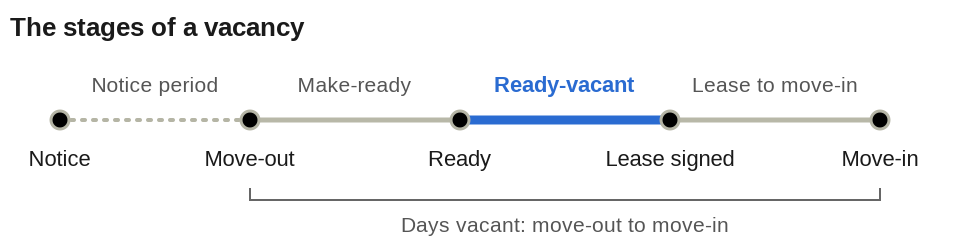
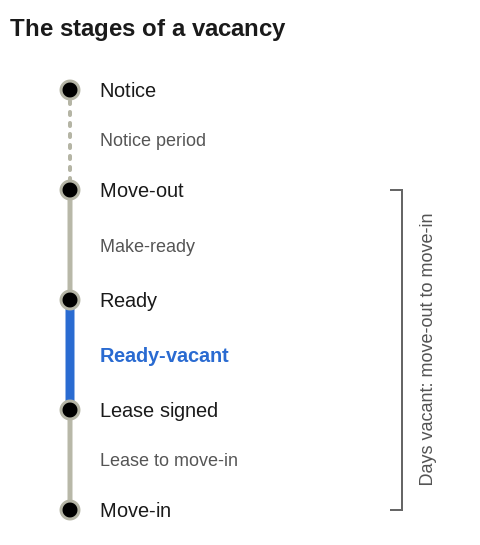
Each stage of a vacancy has its own causes of delay and its own fixes. Measure them from the rent roll and the make-ready log:
Days vacant = Move-in date − Move-out date
Make-ready days = Ready date − Move-out date
Ready-vacant days = Lease signing date − Ready date (or today, for a unit still unleased)
Cost of a vacant day = Monthly rent ÷ 30
Ideally a unit is leased during the notice period, ready within days of move-out and occupied soon after. Asset managers watch ready-vacant days most closely: the unit is finished and earns nothing while it waits for a lease.
How long should a ready unit sit vacant?
It depends on the market and the season, so set thresholds against two things: the property's own history, and how long units take to lease nearby. Local days on market measures the time from listing to a signed lease. A property that lists units during the notice period should beat it; one that lists only after the unit is ready will run close to it.
| Measure | Watch | Act |
|---|---|---|
| Ready-vacant days | 10 days | 14 days |
| Make-ready days, standard turn | 5 days | 7 days |
| Application age, not yet approved | 5 days | 7 days |
| Lease signing to move-in | 14 days | 30 days |
These are starting points. Loosen them in the slow winter months and for unit types with a small pool of renters, such as large three-bedrooms; tighten them when local occupancy is high and units lease quickly.
Why ready units sit vacant, and what to do
Long vacancies usually trace back to one of these causes. Pricing and unit condition are the quickest to confirm, so check them first.
| Cause | How to spot it | Fix |
|---|---|---|
| Priced above comparable units | Asking rent above similar units nearby; showings but no applications | Reprice to market, or add a concession for this unit only |
| Not really ready | Marked ready but failing walk-throughs, or with open work orders | Walk the unit; close the orders before marketing it |
| Weak listing | Few inquiries; old photos, missing floor plan, wrong availability date | Refresh photos and the listing, and confirm it appears on the main rental sites |
| Slow follow-up | Inquiries and tours that never get a call back | Set a response target for leads, and track it |
| Applications stuck in approval | Applications sitting more than a few days | See the next section |
| Something about the unit | The same unit vacant again and again: a busy road, a poor view, an oversupplied floor plan | Price it to clear, or consider an upgrade |
Stalled applications
An application that sits for a week keeps a unit off the market while the applicant keeps looking elsewhere. Applications usually stall for one of these reasons:
-
Missing documents. Pay stubs, ID or a guarantor form never arrived.
-
Income or reference checks waiting. An employer or a prior landlord hasn't answered.
-
A queue at approval. Approvals wait on a manager who reviews them once a week.
-
A move-in date too far out. The applicant wants a date weeks away, and the site holds the unit.
The fix is a short, written process: what's needed to apply, who follows up on missing items and by when, and how long the site will hold a unit. Apply the same process and timelines to every applicant.
Who does what
The property manager works the units every day. They list units during the notice period, track each turn against its ready date, follow up on every lead and application within a set time, and adjust pricing on units that aren't getting applications.
The asset manager checks the exceptions each week. They review every ready unit past the threshold and every application past its age limit, and ask for a reason and a plan for each. Each month, they compare the property's average ready-vacant days with its history and the local market. A unit that appears on the list week after week usually has a pricing or product problem.
Worked example: a vacancy check in Tampa
The property is a hypothetical 240-unit, 2010s building in Tampa (Hillsborough County, FL) with 14 vacant units: 9 ready and 5 in make-ready. Its figures are a sample; the market figures are county data. In Hillsborough County, occupancy averages 94.2% and units take a median of 68 days from listing to a signed lease. Units are often listed while the current resident is on notice, so ready-vacant days at a well-run property should be much shorter.
| Unit | Where it stands (sample) | Threshold: watch / act | Status | Next step |
|---|---|---|---|---|
| 2-104, 1 bed | Ready 22 days; asking rent 6% above comparable 1-beds | 10 / 14 days | 🔴 Act | Reprice to market this week. |
| 3-210, 2 bed | Ready 17 days; 2 tours, no applications | 10 / 14 days | 🔴 Act | Check the listing photos and how fast tours get a follow-up call. |
| 1-008, 2 bed | Marked ready 15 days; 2 open work orders | 10 / 14 days | 🔴 Act | Close the work orders; the unit isn't ready until they're done. |
| 4-312, 3 bed | Ready 12 days | 10 / 14 days | 🟠 Watch | Check next week; 3-beds lease more slowly. |
| 5 other ready units | All under 10 days | 10 / 14 days | 🟢 In line | — |
| 2-201, 1 bed | Application open 9 days, waiting on pay stubs | 5 / 7 days | 🔴 Act | Set a deadline for the documents, then release the unit if they don't arrive. |
| Make-ready | 5 units; 2 past 7 days | 5 / 7 days | 🔴 Act | Get a ready date for each. |
Market figures: county rent data (see Sources).
The three units past 14 days have been ready for 54 days between them. At the county's average rent of $1,874, each vacant day costs about $62, so they've lost about $3,400 so far. Each has its own cause: one is priced above market, one isn't turning tours into applications, and one isn't actually ready.
How RealAI catches long vacancies
Asset Monitor, a feature of RealAI Enterprise, runs these checks on a schedule you choose: daily, weekly, or monthly. It connects to your property management software, or reads the reports you already get.
On each run it checks every unit against the thresholds you set. Its library includes ready units vacant past 14 days, vacant units priced above the comp set and applications stalled over 7 days, and you can add your own.
For the pricing check, it compares each vacant unit's asking rent with a comp set of similar units nearby, drawn from RealAI's rent data. That data tracks more than 20 million listings across 200,000+ properties daily. Tested against owners' actual rent rolls, RealAI's rents were within 0.8% of the signed lease for the typical unit, and its occupancy matched the rent roll for 97% of the units it tracks.
When a unit crosses a threshold, Asset Monitor creates a task and drafts the question to the on-site team for you to review and send, then reads the reply. The task closes when the next run's data shows the unit leased or the issue fixed, or when you dismiss it. The live task list by property shows what's still open and for how long.
FAQs
What is a good number of days vacant for an apartment?
For a ready unit, under about 14 days is a common starting target, shorter in a tight market. Total days vacant, from move-out to move-in, depends on make-ready time too, so track the two stages separately.
How do you calculate days vacant?
Subtract the move-out date from the move-in date. To find where the time goes, split it into make-ready days (move-out to ready) and ready-vacant days (ready to a signed lease).
How much does a vacant apartment cost per day?
About its monthly rent divided by 30. A unit renting for $1,800 a month loses about $60 for each vacant day, before utilities and marketing.
What's the difference between days vacant and days on market?
Days on market runs from the day a unit is listed to a signed lease, and the listing often starts before the unit is empty. Days vacant runs from move-out to move-in.
Sources
- Market data for Hillsborough County, FL: RealAI Rent Index (as of Nov 21, 2026). Accessed Nov 24, 2026.